

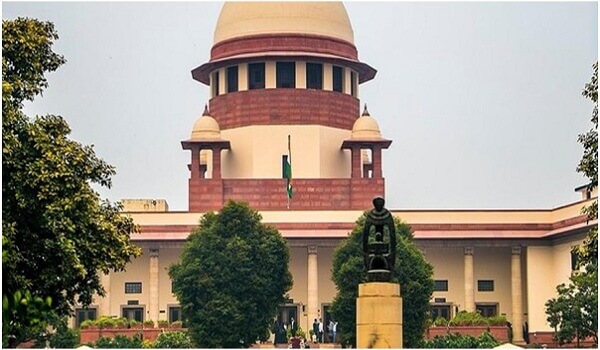
The National Commission for Protection of Child Rights has submitted written arguments in the Supreme Court in the case challenging the Allahabad High Court’s decision to repeal the ‘Uttar Pradesh Madrasa Education Board Act’.On March 22 this year, the Allahabad High Court had declared the Uttar Pradesh Madrasa Education Board Act, 2004 as “unconstitutional” on the ground that it violates the “principle of secularism” and the fundamental rights guaranteed under Article 14 of the Constitution. In this context, the Supreme Court had stayed the decision of the Allahabad High Court, saying that the High Court has prima facie misinterpreted the Act regarding the Madrasa Act and about 17 lakh students will be affected by its decision. According to NCPCR, due to exemption of madrasas from the purview of the Right to Education Act, 2009, all the children studying there are deprived of the right to education along with the formal education provided in schools. They are also deprived of the benefits under the (RTE) Act, 2009 such as mid-day meals, uniforms, trained teachers, etc.
Key features of Uttar Pradesh Madrasa Act
- This Act was passed by the Uttar Pradesh Legislative Assembly in the year 2004.
- Under the Act, Uttar Pradesh Madrasa Education Board was formed, whose objective is to improve the education system of madrasas.
- Under the Act, madrasas were required to meet certain minimum standards to get recognition from the board.
- The State Madrasa Board also has the authority to give guidelines regarding the curriculum, teaching material and training of teachers of madrasas.
- There are about 25,000 madrasas in Uttar Pradesh, out of which 16,500 are officially recognized by the Uttar Pradesh Madrasa Education Board.
Three types of madrasas mentioned by NCPCR
Recognized Madrasas
- These are recognized by the State Madrasa Board. These types of madrassas may provide some degree of formal education along with religious education.
- However, they do not fully comply with the Right to Education Act, 2009.
- Teachers and other officials in recognised madrassas are appointed by the state government.
- Several states and union territories, including Delhi, Assam, Punjab, Tamil Nadu and Telangana, have no recognised madrassas.
Unrecognised madrassas
- These madrassas are ineligible for recognition by state governments due to non-compliance with formal education requirements, inadequate infrastructure and other factors.
- Unrecognised madrassas follow the curriculum prescribed by larger madrassas such as Darul Uloom Nadwatul Ulama (Lucknow) and Darul Uloom Deoband.
Unrecognised madrassas
- These are madrassas that have never applied for recognition from the state government. Funding of Madrasas
- Most of the funding for Madrasas is done by the respective state governments.
- The central government provides financial assistance to Madrasas and minority institutions across the country under the Scheme for Providing Education to Madrasas/ Minorities (SPEMM).
There are two sub-schemes under SPEMM
- Scheme for Providing Quality Education in Madrasas (SPQEM)
- Infrastructure Development of Minority Institutions (IDMI)
- SPEMM was transferred from the Ministry of Minority Affairs to the Ministry of Education in April 2021.
History of Madrasas
- Madrasa is an Arabic word meaning educational institution. In the early days of Islam, mosques also served as centres of education.
- From the 10th century onwards, Madrasas acquired a distinct identity as institutions of religious and secular education in the Islamic world.
- The earliest evidence of madrasas comes from Khorasan and Transoxania, corresponding to modern eastern and northern Iran, Central Asia and Afghanistan.