

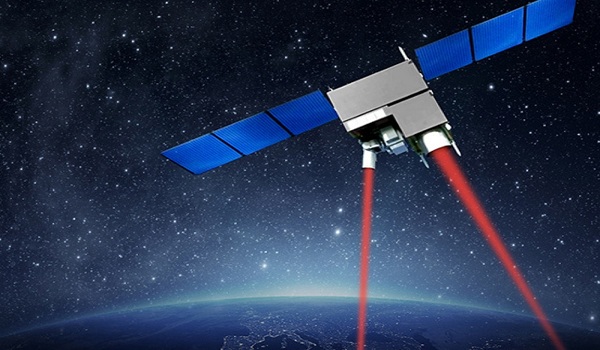
Recently, the Chairman of the Mission Governing Board of the National Quantum Mission announced that India plans to launch a quantum satellite within the next 2-3 years to enable quantum communications.
Quantum Satellite
- A quantum satellite is a communications satellite that uses quantum physics to secure its signals, making it highly resistant to interception.
- It uses quantum cryptography (a method that uses quantum mechanics to encrypt and transmit data), specifically quantum key distribution (QKD), to protect data by detecting eavesdropping during transmission.
Quantum Cryptography
- Encryption Basics: Messages are encoded into a secret code using traditional encryption techniques, such as the Caesar cipher. Without the key, the message cannot be decoded. However, these methods are vulnerable to quantum computers, which can crack codes much faster than conventional supercomputers.
- Quantum Encryption: It uses quantum key distribution (QKD) to secure messages. In quantum measurements, when a quantum system, such as a photon (a tiny particle of light), is measured, its state changes. If an eavesdropper attempts to measure the photon carrying the key, this interference changes the state of the photon. As a result, the legitimate communicating parties will immediately detect that the key has been altered. Furthermore, due to quantum entanglement, any change to one photon has an immediate effect on the other, making it impossible to secretly alter the data. By identifying any interception, QKD provides “unconditional security” and guarantees secure communication.
- Global developments in QKD: China currently operates the world’s largest QKD network, consisting of three quantum satellites and four ground stations. India is advancing its quantum communication experiments with plans for a satellite-based QKD network. Studies by the Raman Research Institute, Bangalore, show that the Indian Astronomical Observatory at Hanle, Ladakh provides ideal conditions for such a system. The Indian Space Research Organisation (ISRO) has successfully demonstrated free-space quantum communication over a distance of 300 metres. The United Nations (UN) has declared the year 2025 as the ‘International Year of Quantum Science and Technology’ to increase public awareness about the importance of quantum science and its applications.
Limitations of quantum key distribution
- Technological maturity: The technology is still in the experimental stage in India, and commercial implementation of large-scale QKD networks is not yet possible.
- Infrastructure cost: QKD requires specialized hardware and infrastructure to implement, increasing the cost compared to traditional cryptography methods.
- Integration: Integrating QKD with existing communication networks and ensuring compatibility with traditional encryption systems presents a significant technical challenge.
- Lack of authentication: QKD does not provide a reliable means to authenticate the source of a transmission, making it vulnerable to potential threats where an adversary can impersonate a legitimate party.
National Quantum Mission
- Launched in 2023 with an investment of Rs 60,000 crore from 2023-24 to 2030-31, NQM aims to advance quantum technologies in India and establish India as a global leader in quantum technologies and applications (QTA).
- Objective: NQM aims to develop quantum computers (build intermediate-level quantum computers with 50-1000 physical qubits (quantum bits) in 8 years) using superconducting and photonic platforms. It will establish satellite-based secure quantum communication within 2000 km in India and internationally. NQM will support inter-city quantum key distribution over 2000 km and develop multi-node quantum networks. It also focuses on building atomic clocks for precision applications.
- Significance: NQM aims to establish India as a global leader in quantum technologies, pushing the boundaries of conventional physics with advanced capabilities beyond current systems.
- National Priorities: NQM is aligned with and supportive of national priorities such as Digital India, Make in India, Skill India, Start-up India and Atmanirbhar Bharat.
- Implementation: The mission will establish four thematic centres in collaboration with top academic and national R&D institutions. The areas of focus of these centres will be quantum computing, quantum communication, quantum sensing and metrology, and quantum materials and devices. These centres will promote innovative knowledge and research by pioneering quantum technology.
- Sectoral impact: The mission will benefit communications, health, financial services, energy and other sectors. Typical applications include drug design, space exploration, and banking and security.