

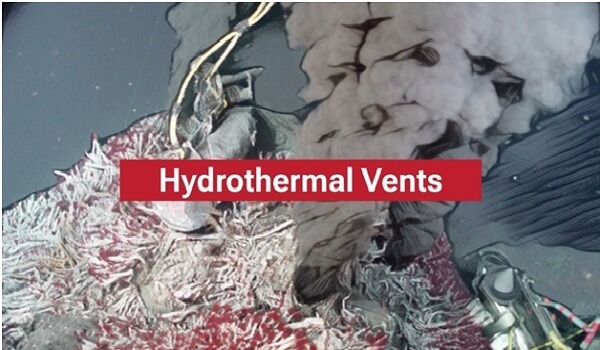
Indian scientists capture rare image of active hydrothermal vent at 4,500 metres depth in Indian Ocean.
Key Points
- Historic discovery: Scientists from National Centre for Polar and Ocean Research (NCPOR) and National Institute of Ocean Technology (NIOT) achieved this feat.
Significance of discovery
- The discovery has been made under the Government of India’s ₹4,000 crore ‘Deep Ocean Mission’.
- This can provide new opportunities in the exploration and use of mineral resources.
- Discovery at depth: The active hydrothermal vent is located at a depth of 4,500 metres, revealing unknown parts of the ocean.
- Scientific significance: The discovery will give a new direction to the study of ocean science and demonstrates India’s technological capabilities.
- Future Prospects: This discovery will encourage research towards sustainable use of mineral wealth in the ocean and maintaining environmental balance.
Active Hydrothermal Vents
- Active hydrothermal vents are natural holes on the ocean floor from which geothermally heated and mineral-rich water flows into the ocean. These create unique ecosystems and geological phenomena.
Process of Formation
- Water intrusion: Ocean water enters through cracks in the ocean layers.
- Heating by magma: The water becomes superheated by the magma present beneath the ocean floor.
- Dissolution of minerals: When heated, the water dissolves minerals from the surrounding rocks.
- Vents formation: This hot and mineral-rich water flows back into the ocean, forming hydrothermal vents.
Geographical Location
- These vents are mainly found in volcanically active regions.
- They are often found in places where oceanic plates are moving apart, such as mid-ocean ridges.
Types of Hydrothermal Vents
Black Smokers
- They spew water hotter than 350°C.
- The presence of sulfides in the water gives it a black colour.
White Smokers
- They spew relatively cooler water.
- They contain light-coloured minerals such as barium, calcium and silicon, which give it a white colour.
Deep Ocean Mission
- Deep Ocean Mission is a flagship initiative of the Government of India, launched in 2021 under the Ministry of Earth Sciences (MoES). It aims to explore and harness the vast resources of the ocean, as well as address challenges in ocean science and marine ecosystems.
Objectives
- Exploration of deep ocean resources: Study and mapping of hydrothermal vents, polymetallic nodules, and cobalt-rich layers found in the Indian Ocean.
- Development of technology for deep ocean mining: Develop and deploy advanced equipment and vehicles for mining up to a depth of 6,000 metres.
- Biodiversity and environmental studies: Conduct research on the unique ecosystems and life forms of the deep ocean.
- Climate change and ocean monitoring: Strengthen India’s capacity to monitor climate change and its impact on the oceans.
- Marine biotechnology and drug development: Study and research of marine organisms for industrial and medicinal use.
Significance
- This mission will enhance India’s deep ocean capability as well as contribute to global ocean research.
- Important for sustainable use of marine resources and biodiversity conservation.
- Helpful in combating climate change and in the development of marine medicines.