

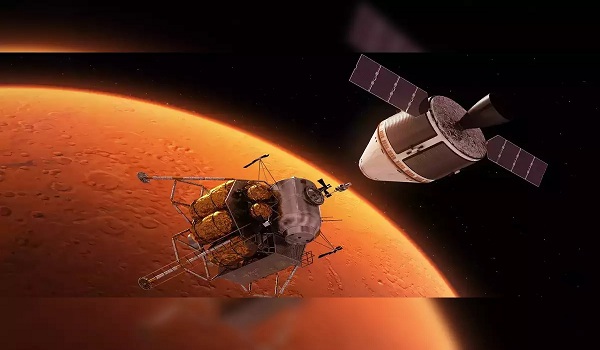
Mission Shukrayaan (Shukrayaan 1), launched by the Department of Space, will study the atmosphere and surface of Venus, as well as investigate its interaction with the Sun.
Venus Orbiter Mission
- India’s first Venus mission, “Shukrayaan-1”, will study the atmosphere, surface and geological features of Venus. It will use advanced scientific instruments.
Objectives
- To study the processes occurring on the surface of Venus and the subsurface structure.
- To study the structure, composition and dynamics of the Venusian atmosphere.
- To explore the interaction between the Sun’s winds and the Venusian ionosphere.
Key features of the mission
- Timeline: India’s Venus mission, which was earlier scheduled to be launched in 2023, will now be launched in March 2028. Earth and Venus come closest every 19 months, so this timeline is important.
- Payloads: The mission will carry around 100 kg of scientific payloads. These payloads will study the thermal state, composition and variations of Venus’ atmosphere, and analyse high-energy particles entering the planet’s ionosphere.
- Launch process: The satellite will gain speed in Earth’s orbit and reach Venus’ orbit in about 140 days.
Payloads of the mission
- 16 Indian payloads: These payloads aim to study various aspects of Venus’ atmosphere and surface.
- 2 Indian and international collaborative payloads (VISWAS and RAVI): These payloads have been developed under collaboration between India and other countries.
- 1 international payload (VIRAL): This payload will help in studying Venus in collaboration with the international scientific community.
Significance of the mission
- Scientific exploration: Will help in understanding the evolution of the heliosphere and the dynamics of planetary atmospheres.
- Understanding Climate Change: Venus’ atmosphere is mainly composed of CO2, so studying its composition will be helpful in understanding the greenhouse effect and environmental problems.
- Other Importance: Obtaining information about atmospheric composition, Earth’s evolution, etc.
Challenges for the Mission
- Extreme Conditions: Extreme temperatures and pressures, which can damage spacecraft components.
- Alkaline Atmosphere: Sulphuric acid clouds present on Venus’ surface which can rust materials like steel and titanium.
- Other Challenges: Difficult physical conditions, lack of sufficient sunlight for solar panels, technical problems, etc.
Missions Launched by Other Countries on Venus
- Missions Conducted in the Past: The United States, Former Soviet Union (USSR), Japan, and European Space Agency (ESA) have sent several missions to Venus.
Recently announced missions
- NASA: “DaVinci” (in 2029) and “Veritas” (in 2031) missions.
- ESA: “EnVision” mission (planned for the early 2030s).
- Russia: “Venera-D” mission (in development).