

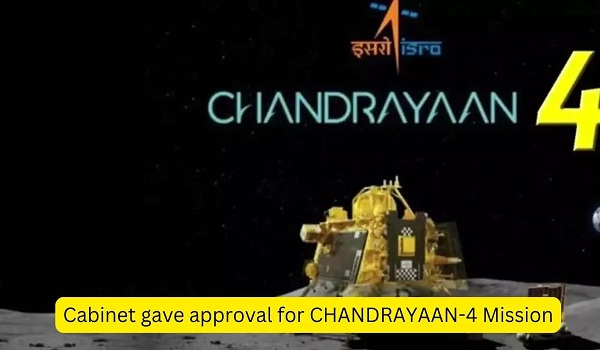
The Union Cabinet has approved the Chandrayaan-4 mission in a meeting chaired by Prime Minister Narendra Modi on 18 September 2024. Venus Orbiter Mission (VOM), Gaganyaan, Indian Space Station and NextGen vehicles were also approved.Indian Space Research Organisation (ISRO), which launched Chandrayaan-1 in 2008, Chandrayaan-2 in 2019 and Chandrayaan-3 in 2023, will lead the Chandrayaan-4 mission.ISRO has been allocated a budget of Rs 2104.06 crore for the Chandrayaan-4 mission, which is to be completed in 36 months.Venus Orbiter Mission (VOM) The cost budget of this mission is Rs 1,236 crore and it will be launched in March 2028 to study the planet Venus. These missions reflect India’s growing capabilities and ambitions in space research.
Chandrayaan-4 Mission
- Chandrayaan-4 mission is an ambitious space mission of India, which is being developed by the Indian Space Research Organization (ISRO).
- The main objective of this mission is to collect samples from the surface of the moon and bring them back to Earth.
- This is the fourth mission of India’s Chandrayaan program, which started in 2003.
- The total cost of the mission has been fixed at Rs 2104.06 crore, which includes spacecraft development, two LVM3 launches, support of the Deep Space Network, and special tests.
Major goals and objectives of the mission
- The main objectives and goals of the Chandrayaan-4 mission are as follows –
- Develop and demonstrate the technologies required to land on the moon and return and develop the technology required for successful landing on the moon.
- Successfully land on the moon and collect samples and bring those samples back safely to Earth and analyze them.
- Cost and time frame of the mission: The total cost of this mission is ₹ 2104.06 crore, while the period to complete this mission has been fixed at 36 months.
- Mission launch and related technical details: This mission will be launched in two stages through two LVM3 rockets. It will consist of various modules like ascender module, descender module, propulsion module, transfer module and re-entry module.
- Industry and academia participation and India’s future plans: This mission will have significant participation of industry and academia, which will promote technological development and research and along with this, after the successful completion of Chandrayaan-4 mission, India is planning to send a manned mission to the Moon.
- This mission will not only collect samples from the surface of the moon but will also demonstrate the technologies required for future space missions. Hence, Chandrayaan-4 mission will prove to be an important milestone in India’s space program.
Venus Orbiter Mission
- Venus Orbiter Mission (VOM) or Shukra Orbiter Mission, also known as Shukrayaan-1, is an upcoming mission of ISRO, which is targeted to launch in 2028. The objective of this mission is to study the surface, subsurface and atmosphere of Venus to understand the evolution of life on this planet.
- Launch time frame and estimated budget of expenditure in this mission: This mission, to be launched in March 2028, has been approved with a budget of Rs 1,236 crore, out of which Rs 824 crore will be spent on the spacecraft.
- Mission duration: The duration of this mission has been fixed at 4 years.
- Spacecraft details and orbit and payload status: The spacecraft will operate in an elliptical orbit with an apoapsis distance of 60,000 km and a periapsis distance of 500 km. Its payload is 100 kg and it will be powered by 500 watts.
- Areas of study: The objective of this mission is to study the interaction of solar wind with Venus’s surface, atmosphere, volcanic activity and ionosphere.
- Technology and Collaboration at International Level: Collaboration has been established with NASA, CNES (France) and Russia for the payload and technology of this mission. Hence, this mission will provide valuable information about the evolution of Venus and Earth and will further strengthen India’s position in space research and open the door to new possibilities in the field of Indian science and technology.