

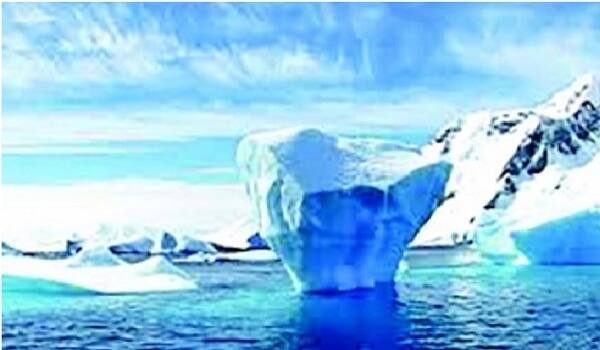
Recent research highlights a critical link between declining Arctic Sea ice and the increasingly unpredictable patterns of the Indian monsoon. The findings have significant implications for climate science and weather forecasting, particularly in light of recent severe weather events in India.
Arctic Sea Ice Influences the Indian Monsoon
- Central Arctic Sea Ice Decline: Less Arctic Sea (sea ice cover of the Arctic Ocean and its vicinity) leads to reduced rainfall in western and peninsular India, but increased rainfall in central and northern India.This is due to increased heat transfer from the ocean to the atmosphere, strengthening Rossby waves, which alter global weather patterns.Enhanced Rossby waves cause high pressure over northwest India and low pressure over the Mediterranean, shifting the subtropical easterly jet northward, resulting in more rain over western and peninsular India.
- Low Sea Ice in the Barents-Kara Sea Region: Low sea ice in the Barents-Kara Sea leads to higher pressure over southwest China and a positive Arctic Oscillation, which affects global weather patterns.Reduced sea ice causes heat to rise, creating calm, clear skies over northwest Europe.This disruption impacts upper atmospheric conditions in subtropical Asia and India, resulting in high rainfall over northeastern India, while central and northwest regions experience less rain.
- Climate Change’s Role: The warming Arabian Sea and moisture from surrounding water bodies further destabilise weather patterns, exacerbating the variability in monsoon rainfall.
Findings of the Study Related to Surplus Rain in North-Western (NW) India
- Increased Moisture from the Arabian Sea: NW India is experiencing a wetter monsoon season due to increased moisture inflow from the Arabian Sea. This trend is expected to continue, particularly under high emissions scenarios.
- Changes in Wind Patterns: The region’s increased rainfall is linked to altered wind patterns. Faster winds over the Arabian Sea and slower winds over northern India trap moisture in northwestern India.Enhanced evaporation from the Arabian Sea, driven by these winds, also contributes to the region’s increased precipitation.
- Shifts in Pressure Gradients: Changes in wind patterns are attributed to shifts in pressure gradients.Increased pressure around the Mascarene Islands (Indian Ocean) and decreased pressure in the equatorial Indian Ocean have strengthened the monsoon winds that bring rain to northwestern India.
- Amplified Winds from East-West Pressure Gradient: An increased east-west pressure gradient, influenced by higher pressure over the eastern Pacific, further amplifies these winds. This could potentially lead to even wetter monsoons in the future.
Rossby Waves
- These are large-scale atmospheric waves, also called planetary waves, that occur primarily in the mid-latitudes of the Earth’s atmosphere.
- They form in jet streams with high-altitude air currents flowing from west to east and have a meandering pattern that influences weather across the Northern and Southern Hemispheres.
- These waves are most prominent where there is a large temperature contrast between the equator and the poles.
- They play a key role in shaping global weather patterns, affecting temperature extremes and precipitation levels.
- Rossby waves help balance global heat distribution, preventing polar regions from becoming too cold and equatorial regions from overheating.
Indian Summer Monsoon Rainfall (ISMR)
- The Indian summer monsoon rainfall (ISMR) occurs from July to September, with most rains recorded in July and August. It is one of the most prominent monsoon systems in the world.
- During summer, the Central Asian and Indian landmass heats faster than surrounding oceans, creating a low-pressure band at the Tropic of Cancer, known as the intertropical convergence zone.
- Trade winds from the southeast, deflected by the Coriolis force, blow over the Arabian Sea and gather moisture, bringing rain to India.
- The southwest monsoon splits into two:
- The Arabian Sea arm brings rain to the west coast.
- While the Bay of Bengal arm brings rain to eastern and northeastern India, converging over Punjab and Himachal Pradesh.