

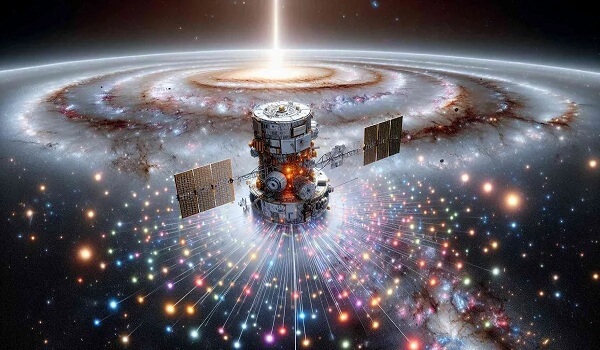
ISRO’s Astrosat has successfully detected its 600th Gamma-Ray Burst (GRB). This event has been named GRB 231122B.
Gamma-ray burst
- Gamma-ray bursts (GRBs) are momentary bursts of gamma-ray light, the most energetic form of light. Lasting from a few milliseconds to several minutes, GRBs are hundreds of times brighter than a typical supernova and about a million trillion times brighter than the Sun.
- When a GRB burst occurs, it is the brightest source of brief cosmic gamma-ray photons in the observable universe.
- Long duration bursts last from 2 seconds to a few hundreds of seconds (several minutes), with an average time of about 30 seconds. They are associated with the end of massive stars in supernovae; However not every supernova produces a gamma-ray burst.
- Short duration bursts are those that last less than 2 seconds; These can range from a few milliseconds to 2 seconds, with an average duration of about 0.3 seconds (or 300 milliseconds). These explosions appear to be associated with the merger of two neutron stars into a new black hole or the merger of a neutron star with a black hole to form a larger black hole.
AstroSat
- Astrosat is the first Indian mission dedicated to astronomy. Its objective is to simultaneously study celestial sources in the X-ray, optical and UV spectral bands.
- Astrosat with a lift-off mass of 1515 kg was launched by PSLV-C30 on September 28, 2015 from the Satish Dhawan Space Center in Sriharikota into a 650 km orbit inclined at an angle of 6 degrees to the equator. The minimum useful life of the AstroSat mission is expected to be 5 years.