

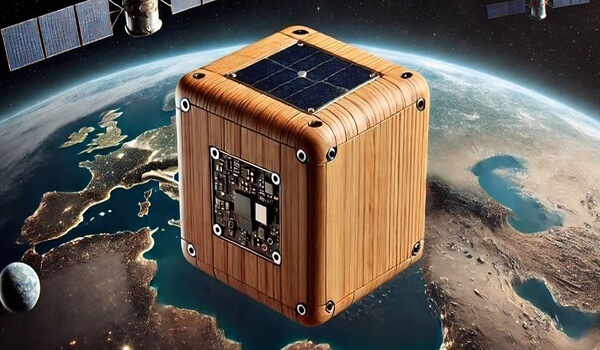
Lignosat, developed by Kyoto University and homebuilder Sumitomo Forestry, is on a SpaceX mission to the International Space Station. It will later be released into orbit about 400 km (250 miles) above Earth.It is named after the Latin word “ligno” for “wood” and “satellite”. It was developed by researchers from Kyoto University and Sumitomo Forestry Company.
Lignosat features
- Construction material: Lignosat is made from specially selected magnolia wood, which is known for its durability and adaptability.
- Launch and testing: It will be sent to the International Space Station (ISS) from the Kennedy Space Center via a SpaceX rocket. There it will be released into space from the Japanese Experiment Module, where its durability and strength will be tested.
- Objective: LignoSat aims to test the eco-friendliness and cost-effectiveness of wood in space exploration, so that renewable materials can be used during future spaceflights.
Importance of Wooden Satellite
- Wooden satellites are more environmentally friendly, as they burn up during re-entry into the atmosphere, which does not create metal particles and reduces the chances of air pollution.
- It is cost-effective as well as has a low environmental impact on Earth, which can make space exploration more sustainable.
International Space Station
- The International Space Station (ISS) is one of the most complex and massive international scientific and engineering projects in history, the largest structure ever established by humanity in outer space. It is an advanced laboratory, a test center for high-altitude satellite flight, and a platform for astronomical, environmental, and geological research. The ISS is also considered a milestone for future space exploration, the first step towards the creation of a permanent spaceport in outer space.
Key Features
- Location and Speed: The ISS is located at an altitude of about 400 kilometers above the Earth and orbits the Earth every 90 minutes at a speed of about 28,000 kilometers per hour.
- Performance: The ISS can be seen as a bright moving light in the night sky, visible even without a telescope if its position and time are known.
- Cost and Participation: It was built by five major space agencies (NASA, Roscosmos, JAXA, ESA, and CSA) representing 15 countries, at a cost of about US$100 billion.
- Structure and Operations: The ISS was gradually built in orbit through various modules and nodes, including habitable quarters, laboratories, and external trusses that support the structure as well as provide power through solar panels.
Evolution journey
- Launch modules: The first module, Russia’s Zarya, was launched in 1998.
- Crew: The initial crew consisted of three people, although it was temporarily reduced to two members after the Columbia shuttle accident. The size was increased to six members in 2009, when new modules and laboratories were added.
- Extension: The ISS was initially scheduled to operate until 2020, which has been extended to 2024 at NASA’s request.