

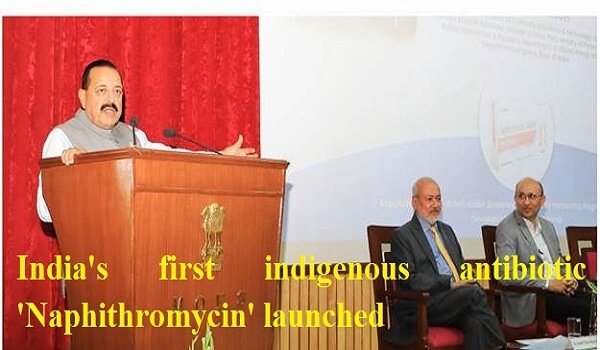
Union Minister Dr Jitendra Singh formally launched Naphithromycin, India’s first indigenous antibiotic for drug-resistant infections.
Key Points
- Launch: Union Minister Dr Jitendra Singh launched India’s first indigenous antibiotic ‘Naphithromycin’.
- Development: It was developed with the support of Biotechnology Industry Research Assistance Council (BIRAC).
- Trade name: It was marketed by pharma company Wockhardt as ‘Miqnaf’.
- Purpose: It has been developed to fight antimicrobial resistance (AMR).
- Solution to the problem: Naphithromycin will prove to be revolutionary in the treatment of drug-resistant pneumonia, which causes more than 2 million deaths every year.
- Efficacy: It is 10 times more effective than Azithromycin and gives similar results in just three days of treatment.
- Target: It targets both common and uncommon pathogens.
- Research and investment: It took 14 years and an investment of ₹500 crore to develop it.
- Clinical trials: Successful trials in the US, Europe, and India.
- Approvals: It is awaiting final approval from the Central Drugs Standard Control Organisation (CDSCO).
Other details
- Unique solution: Nafithromycin is a new generation drug, which provides faster, safer and more tolerable treatment.
- Need for the drug: Resistance to current drugs is seen in 23% of pneumonia cases in India.
- Collaboration: It is an excellent example of public and private sector collaboration.
- First in the world: No new antibiotic in this class was developed in the last 30 years.
Conclusion
- With the development of ‘Nafithromycin’ antibiotic, India is playing a leading role in fighting antimicrobial resistance (AMR). This is a major achievement in the health sector not only for the country but also globally.
Antibiotics
- Antibiotics are used to treat bacterial infections.
- They kill bacteria or prevent their reproduction.
Nafithromycin
- It is an antibiotic drug.
- It is specifically designed to treat community-acquired bacterial pneumonia.
Pneumonia
- This serious disease is caused by drug-resistant bacteria.
- It disproportionately affects children, the elderly, and individuals with weakened immune systems such as diabetes or cancer patients.
- The lungs are most affected.
- Respiratory problems and increased risk of pneumonia
Impact of respiratory problems
- Diseases such as asthma, bronchitis, and pneumonia put additional pressure on the health sector.
- Lung infections can lead to serious health problems.
Serious effects of pneumonia
- Causes millions of deaths each year.
- Particularly deadly on children and the elderly.
- According to WHO, more than 2.5 million children under the age of 5 die from pneumonia each year.