

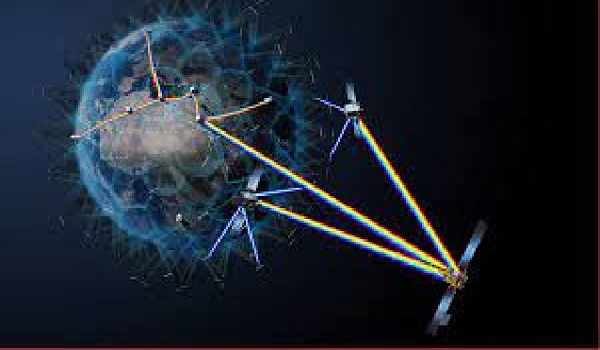
The European Space Agency has announced the ‘Hydron’ project to develop its own satellite network for space-based internet.
Hydron Project
- ESA’s Hydroon project plans to revolutionise internet communication by using laser signals to transmit data between satellites in space.
- This network will be capable of providing internet speeds of about one terabyte per second.
The Hydroon project system consists of two major components
- Scientific research to build the network
- Initial demonstrations to conduct tests
The project will use satellites in both low orbit (1,000 km above Earth) and geostationary orbit (about 36,000 km).
Features of Hydroon Project
- Traditionally satellites send radio communication signals from space to receivers located on Earth which then distribute the information to various services such as cellphone holders and air traffic control.
- A key aspect of Hydron is the use of lasers to transmit data between satellites.
- This approach not only speeds up data transfer but also increases security.
- This makes it resistant to signal interception by cybercriminals and unaffected by bad weather.
Objectives of the Hydron project
- To create a spoof-proof mega-constellation of satellites to deliver high-speed broadband
- To reduce reliance on ground systems and increase efficiency and reliability
- To address the growing need for data
- To provide internet access to remote areas lacking broadband
- To provide high-quality video streaming to users
Benefits to the European continent from the Hydron project
- According to ESA, this technology will transform Europe’s optical telecommunications industry, enabling the continent to lead this fast-growing market.
- Public sector customers such as the European Union’s operational space programme and security agencies are likely to be the first users of the Hydrone network.
- SpaceX’s Starlink has already established a network of low-Earth orbit satellites using similar technology.
- However, ESA’s Hydrone system aims to have greater data capacity and wider coverage.
- ESA plans a phased launch of Hydrone between 2027 and 2029.